
Architecture
SIE has two runtime shapes. A single Docker sie-server exposes the server API in one process. A Kubernetes cluster splits the path across a Rust gateway, NATS, GPU worker pods, and a dedicated config service. Each worker pod runs the SIE server sidecar beside the Python sie-server adapter process.
System Overview
Section titled “System Overview”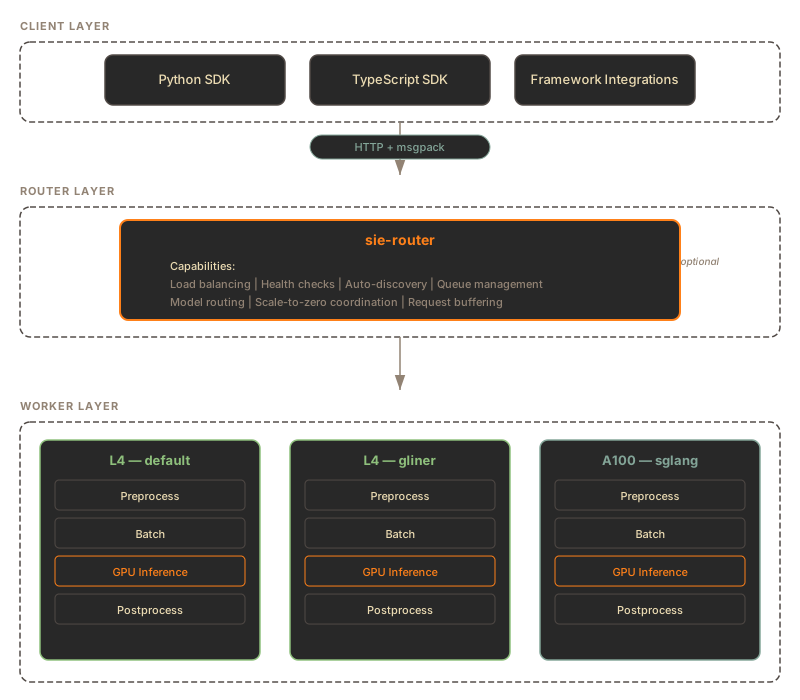
In production Kubernetes deployments, the hot path is intentionally separate from the config control plane:
Client SDK  -> sie-gateway (Rust, stateless inference edge)  -> NATS JetStream queue  -> SIE server sidecar inside the worker pod  -> UDS IPC  -> sie-server adapter process  -> NATS Core result inbox  -> sie-gateway response
Admin tooling  -> sie-config (Python, single-writer config control plane)  -> config store + NATS config deltas  -> gateways and worker pods converge asynchronously
Components
Section titled “Components”Client SDK
Section titled “Client SDK”The SDK provides encode(), score(), and extract() methods. It handles:
- msgpack serialization: Binary wire format, faster and smaller than JSON
- Automatic 503 PROVISIONING retry: Waits for scale-from-zero with
wait_for_capacity=True - Pool management: Background lease renewal for resource pools
- Numpy integration: Returns native numpy arrays for embeddings
Framework integrations (LangChain, LlamaIndex, etc.) wrap the SDK with framework-specific interfaces.
Gateway
Section titled “Gateway”The gateway is a stateless Rust service that sits between clients and Kubernetes worker pods. It is optional for single-server setups but required for elastic Kubernetes clusters.
Responsibilities:
- Resolves model, bundle, machine profile, and pool from its in-memory registry
- Publishes inference work to NATS JetStream
- Returns
503with error codePROVISIONINGand aRetry-Afterheader when the target worker pool is scaled to zero - Serves read-side config endpoints from its local registry mirror
- Manages resource pools for capacity isolation
- Tracks worker-pod health and bundle config hashes from SIE server sidecar NATS heartbeats
The gateway does not own config writes. POST /v1/configs/models, GET /v1/configs/export, and GET /v1/configs/epoch belong to sie-config.
Config Service
Section titled “Config Service”sie-config is the authoritative config control plane. It runs as a single writer, persists API-added model configs, and publishes runtime config deltas:
POST /v1/configs/modelsappends new models or profiles.GET /v1/configs/exportgives gateways a full snapshot for bootstrap and drift recovery.GET /v1/configs/epochexposes the authoritative model-write epoch and bundle-set hash.GET /v1/configs/bundles{,/{id}}lets gateways fetch the bundle set baked into thesie-configimage.
Gateways bootstrap from sie-config, subscribe to sie.config.models._all for live deltas, and poll /v1/configs/epoch to recover any missed NATS messages.
SIE Server Sidecar
Section titled “SIE Server Sidecar”Every queue-mode worker pod includes the SIE server sidecar. The Helm chart enables it by default and renders the container as worker-sidecar.
The image repository is ghcr.io/superlinked/sie-server-sidecar. It owns the queue half of the worker pod’s cluster hot path:
- Pulls work from the pool’s NATS JetStream stream
- Validates subjects and reply inboxes before processing payloads
- Forms batches by model, operation, and LoRA key
- Calls the Python
sie-serveradapter process over Unix domain socket IPC - Frames results, publishes them to the gateway inbox, and ACKs or NAKs JetStream messages
- Publishes
sie.health.<worker_id>heartbeats with queue depth, loaded model state, and the currentbundle_config_hash - Applies bundle-scoped config deltas to the
sie-serveradapter through IPC and reconciles missed deltas fromsie-config
The SIE server sidecar does not load model weights and does not link GPU libraries. It keeps queue, batching, payload, and framing work in Rust while the sie-server adapter remains responsible for model execution.
Worker Adapter (sie-server)
Section titled “Worker Adapter (sie-server)”sie-server remains the Python model-execution process. In standalone Docker it exposes the server API. In Kubernetes queue mode, it runs beside the SIE server sidecar inside each worker pod and exposes an IPC server to execute prepared batches.
It owns:
- Model registry and GPU lifecycle
- Adapter-specific preprocessing and model-path selection
- Model loading, LoRA loading, and memory pressure eviction
- GPU inference through PyTorch, Flash Attention, SGLang, and other adapter backends
- The single-process API used by Docker deployments
Queue-mode batches from the SIE server sidecar arrive as fully formed GPU work. The sie-server adapter can still retokenize an item when that is the safe execution path.
Wire Protocol
Section titled “Wire Protocol”SIE uses msgpack as the default wire format instead of JSON:
| Format | Encode speed | Decode speed | Size | Numpy support |
|---|---|---|---|---|
| msgpack | Fast | Fast | ~50% of JSON | Native via msgpack-numpy |
| JSON | Slower | Slower | Baseline | Requires list conversion |
The SDK sends and receives msgpack automatically. The OpenAI-compatible /v1/embeddings endpoint uses JSON for compatibility.
Inside a Kubernetes cluster, gateway-to-sidecar work items, IPC frames between the SIE server sidecar and the sie-server adapter, and sidecar-to-gateway results are msgpack as well. JSON is reserved for low-frequency control-plane APIs and client requests that explicitly negotiate JSON.
Model Cache Hierarchy
Section titled “Model Cache Hierarchy”Model weights are resolved through a 3-tier cache:
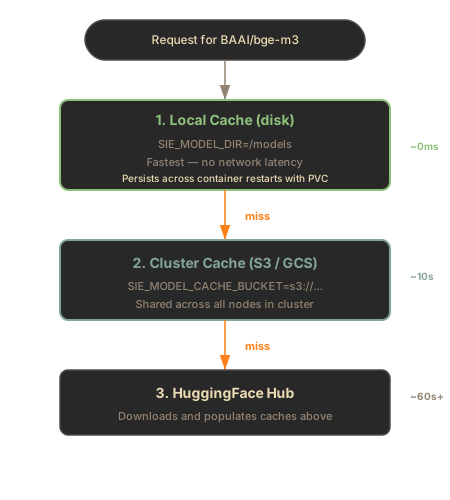
Local disk cache uses LRU eviction when disk usage exceeds SIE_DISK_PRESSURE_THRESHOLD_PERCENT (default: 85%).
Cluster cache is useful for Kubernetes deployments where multiple worker pods share the same S3/GCS bucket, avoiding redundant downloads from HuggingFace.
Deployment Modes
Section titled “Deployment Modes”Standalone Docker
Section titled “Standalone Docker”Client → sie-server (single GPU)Simplest setup. The SDK points at one sie-server process. Good for development and small production.
Multi-Bundle (Docker Compose)
Section titled “Multi-Bundle (Docker Compose)”Client → sie-server:8080 (default bundle)Client → sie-server:8081 (sglang bundle)Multiple containers, each with a different bundle. Client routes to the correct port.
Cluster (Kubernetes)
Section titled “Cluster (Kubernetes)”Client → sie-gateway → NATS JetStream → SIE server sidecar → UDS IPC → sie-server adapterAdmin → sie-config → config store + NATS config deltas → gateway + worker podFull production setup with GPU routing, autoscaling, and observability. See Kubernetes in GCP or AWS.
What’s Next
Section titled “What’s Next”- Request Pipeline - detailed preprocessing, batching, and GPU inference flow
- Gateway - routing, queueing, load balancing, and resource pools
- Config API - runtime model config writes and readiness polling
- Adapters - compute engine abstraction layer